
Pipette Tips for Laboratory Research: Types, Applications and Selection Guide
Pipette Tips for Laboratory Research: Types, Applications and Selection Guide
Pipette tips are essential laboratory consumables used in precision liquid handling, molecular biology, biochemistry, microbiology, and analytical research. Selecting the appropriate pipette tip can influence liquid transfer accuracy, sample recovery, contamination control, and experimental reproducibility.
This scientific guide explores standard pipette tips, filter pipette tips, low-retention tips, sterile variants, and DNase/RNase-free options. It also examines the importance of pipette tip geometry, sample properties, and selection criteria for modern laboratory workflows.
=> A pipette tip is a disposable component fitted to a compatible micropipette to aspirate and dispense defined liquid volumes. Standard tips support routine liquid handling, filter tips reduce aerosol-related contamination risks, and low-retention tips are designed to minimize liquid remaining on the tip walls. Sterility and DNase/RNase-free status are separate characteristics that must be verified for each product.
1. What Are Pipette Tips and Why Are They Important in Laboratory Research?
Pipette tips are disposable laboratory accessories used with manual or electronic micropipettes. They form the liquid-contact component of the pipetting system, enabling researchers to transfer measured volumes of samples, reagents, buffers, and biological solutions.
In air-displacement pipetting, the piston changes the volume of an air cushion inside the pipette. This pressure variation allows liquid to be aspirated into or dispensed from the attached tip.
The reliability of liquid transfer depends on several interacting factors, including pipette calibration, tip geometry, pipette-tip compatibility, liquid properties, environmental conditions, and operator technique.
Scientific Importance of Pipette Tips
- Accurate liquid transfer : Support controlled aspiration and dispensing of experimental volumes.
- Reproducibility : Help maintain consistent liquid handling across experimental replicates.
- Contamination control : Disposable tips reduce direct carryover between samples when replaced appropriately.
- Sample recovery : Suitable tip surfaces can reduce liquid retention during dispensing.
- Workflow compatibility : Different geometries and volume ranges support different experimental requirements.
Pipette tips are widely used in PCR preparation, DNA and RNA extraction, ELISA assays, protein analysis, cell culture, sample preparation, and routine laboratory dilution procedures.
2. Understanding the Main Types of Laboratory Pipette Tips
Different laboratory procedures require different pipette tip characteristics. The most common distinctions involve filtration, surface retention, sterility, and volume capacity.
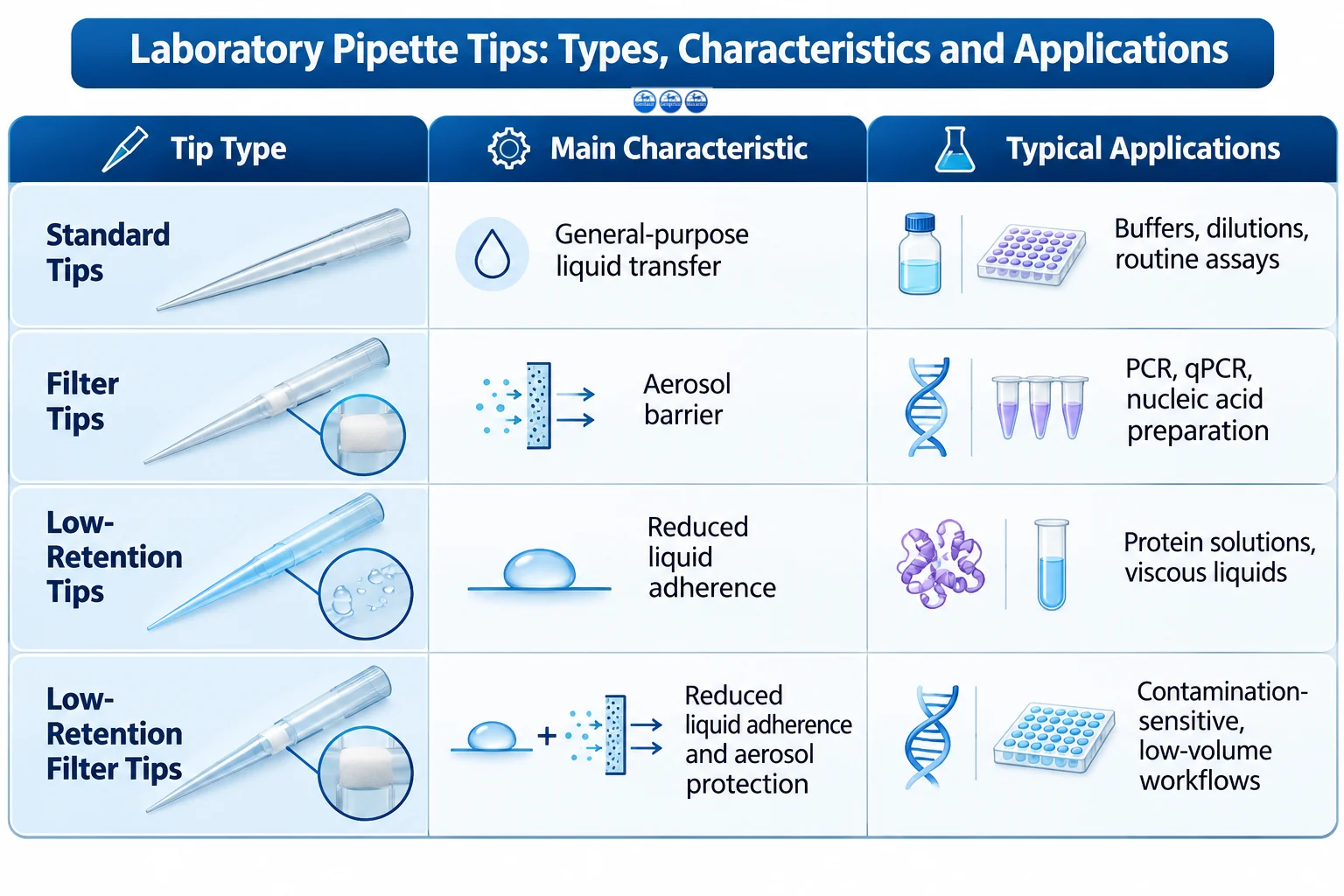
Standard Pipette Tips :
=> Standard pipette tips are designed for routine liquid transfer and are commonly used for aqueous solutions, buffers, dilution series, and general sample preparation.
They are available in different nominal volume ranges and may be supplied as sterile or non-sterile variants.
Filter Pipette Tips :
=> Filter pipette tips contain a barrier positioned within the upper portion of the tip. Its purpose is to reduce the passage of aerosols and droplets toward the pipette shaft.
=> They are especially useful when handling contamination-sensitive samples, including nucleic acids and PCR reagents.
Low-Retention Pipette Tips :
=> Low-retention pipette tips are designed to reduce the amount of liquid remaining on the inner wall following dispensing.
=> They may be advantageous for viscous liquids, solutions containing proteins, detergents, or other materials that tend to adhere to plastic surfaces.
Low-Retention Filter Pipette Tips :
=> Low-retention filter tips combine a liquid-repellent surface with an aerosol barrier. These properties address two separate challenges: sample retention and contamination control.
Comparison of Pipette Tip Types
3. The Science of Accurate and Precise Pipetting
Accurate and precise pipetting is essential for quantitative laboratory research. Even small liquid-handling errors can affect reagent concentrations, reaction kinetics, standard curves, and analytical measurements.
Accuracy Versus Precision
- Accuracy describes how closely a measured or dispensed volume approaches the intended value.
- Precision describes the consistency of repeated measurements or dispensing operations.
A pipetting system may produce highly consistent results while still transferring a volume that differs systematically from the target.
Factors Influencing Pipetting Performance
- Calibration condition of the micropipette.
- Mechanical compatibility between the pipette and tip.
- Tip dimensional consistency and sealing quality.
- Liquid viscosity, density, and surface tension.
- Aspiration and dispensing speed.
- Immersion depth and pipetting angle.
- Pre-wetting and equilibration procedures.
For example, when pipetting highly viscous solutions, slow aspiration and dispensing techniques may improve liquid transfer consistency.
The ISO 8655 series addresses the performance and testing of piston-operated volumetric apparatus. Pipette and tip performance should be evaluated together because the attached tip can influence volumetric results.
Consequently, selection should not depend exclusively on the printed volume range. Reliable compatibility and validated performance are equally important.
4. Filter Pipette Tips and Laboratory Contamination Control
Contamination control is especially important in analytical procedures capable of detecting extremely small quantities of biological material.
During pipetting, aerosols can form through liquid movement, aspiration, dispensing, and sample mixing. These suspended droplets may contain nucleic acids, proteins, microorganisms, or other sample components.
In an air-displacement pipette, aerosols or accidentally aspirated liquid may enter the lower portion of the instrument and contribute to sample carryover.
How Filter Pipette Tips Work ?
Filter pipette tips contain a porous barrier that limits the movement of droplets and aerosols toward the pipette cone.
The extent of protection depends on the filter material and construction. Conventional filters and self-sealing barriers may perform differently, especially in accidental over-pipetting situations.
Applications of Filter Tips
- PCR and real-time quantitative PCR (qPCR).
- DNA and RNA sample preparation.
- Genetic analysis and sequencing workflows.
- Clinical and molecular diagnostic research.
- Cell culture and microbiological research.
- Workflows involving sensitive or potentially hazardous samples.
Filter tips are not a substitute for good laboratory practice, instrument cleaning, proper handling procedures, or validated containment measures.
Filter performance, sterility, and nucleic acid contamination specifications should be confirmed from the product's technical documentation.
5. Low-Retention Pipette Tips: Surface Properties and Sample Recovery
During liquid dispensing, a portion of the sample may remain attached to the inner wall of a conventional pipette tip. This phenomenon is influenced by surface chemistry, liquid composition, and interactions between the sample and plastic material.
Low-retention pipette tips are designed to minimize residual liquid after dispensing.
Scientific Principles of Liquid Retention
The interaction between a liquid and a solid surface is governed by factors such as surface tension, interfacial energy, wetting behavior, and molecular adhesion.
A surface that reduces wetting or adhesion may facilitate more complete liquid release under appropriate conditions.
Applications of Low-Retention Pipette Tips
- Handling concentrated protein solutions.
- Preparing antibody and enzyme mixtures.
- Transferring solutions containing detergents.
- Handling glycerol-containing reagents.
- Working with small volumes of valuable samples.
- Preparing sensitive biochemical assay mixtures.
Reduced liquid retention is particularly relevant when transferring small volumes, where residual droplets may represent a meaningful proportion of the intended dispensing volume.
However, low retention does not automatically guarantee low protein binding or improved recovery of every biomolecule. These performance characteristics require application-specific validation.
6. Sterile and DNase/RNase-Free Pipette Tips for Molecular Biology
In molecular biology, contamination may compromise sample integrity and affect downstream analytical results.
Two important but distinct product characteristics are sterility and freedom from detectable nuclease contamination.
What Does Sterile Mean?
Sterile pipette tips are supplied after an established sterilization process intended to meet the manufacturer's specified sterility requirements.
They may be selected for procedures requiring sterile handling, such as certain cell culture and microbiological applications.
What Does DNase/RNase-Free Mean?
DNases and RNases are enzymes that degrade DNA and RNA, respectively.
DNase/RNase-free pipette tips are manufactured and tested according to defined criteria intended to limit nuclease contamination.
This characteristic is particularly important for RNA handling because RNA can be susceptible to enzymatic degradation.
Are Sterile and DNase/RNase-Free Tips the Same?
No. Sterility and nuclease cleanliness are separate specifications.
| Characteristic | Meaning | Research Relevance |
|---|---|---|
| Sterile | Processed to meet a defined sterility specification | Cell culture and aseptic workflows |
| DNase-Free | Meets specified testing criteria for DNase contamination | DNA sample preparation |
| RNase-Free | Meets specified testing criteria for RNase contamination | RNA extraction and analysis |
| Filter Barrier | Designed to limit aerosol or liquid transfer toward the pipette | Contamination-sensitive assays |
Researchers should verify all relevant certifications and testing claims separately. DNase/RNase-free labeling does not automatically establish the absence of human DNA, PCR inhibitors, endotoxins, or other contaminants.
7. Pipette Tip Volume Ranges, Geometry and Packaging
Selecting a pipette tip requires matching the intended liquid volume with the compatible pipette and tip capacity.
The accompanying product catalog includes pipette tips covering a broad range of nominal liquid-handling capacities, including microvolume and large-volume applications.
Available Pipette Tip Volume Ranges
Not every volume range is available in every pipette tip family. Researchers should consult the specific catalog listing and confirm compatibility with their instruments.
Extended and XL Pipette Tips
Extended-length tips can be useful when accessing samples in deeper tubes or containers. Depending on their geometry and compatibility, they may also help reduce contact between the pipette body and the vessel opening.
XL and graduated tip variants provide alternative physical dimensions or visible volume markings according to their product design.
Racked Packaging
The product range includes racked pipette tips supplied in packaging configurations such as:
- 10 × 96 tips per pack, corresponding to 960 tips.
- 6 × 24 tips per pack, corresponding to 144 tips.
Racked packaging supports organized tip handling, inventory management, and convenient access during repeated liquid-handling procedures.
8. Choosing Pipette Tips for PCR, qPCR, ELISA and Protein Research
The choice of pipette tip should reflect the analytical sensitivity of the procedure, the physical characteristics of the liquid, and the contamination risks associated with the experiment.
PCR and qPCR
=> PCR and qPCR assays are sensitive to contamination with extraneous nucleic acids and amplified DNA products.
=> Appropriately validated filter tips are commonly selected for these workflows, together with good laboratory segregation, reagent handling, and contamination-control practices.
DNA and RNA Extraction
=> During nucleic acid purification, nuclease cleanliness and sample carryover are important considerations.
=> DNase/RNase-free tips are relevant to these applications, while filter barriers may provide additional protection against contamination of the pipetting instrument.
ELISA and Immunoassays
=> ELISA workflows involve repeated handling of samples, standards, controls, conjugates, and assay reagents.
=> Consistent liquid transfer is important because pipetting variation may influence signal intensity, standard curves, and quantitative results.
Protein and Enzyme Studies
=> Protein solutions, enzyme preparations, and reagents containing detergents or glycerol may exhibit handling difficulties related to viscosity or adhesion.
=> Low-retention tips may help reduce residual liquid, although their suitability should be verified experimentally for the specific formulation.
Application Selection Table
| Research Application | Potential Tip Choice | Selection Priority |
|---|---|---|
| PCR / qPCR | Filter tips | Contamination control |
| RNA Preparation | DNase/RNase-free filter tips | Sample integrity |
| Protein Assays | Low-retention tips | Sample recovery |
| Cell Culture | Sterile tips | Aseptic handling |
| Routine Buffer Preparation | Standard tips | Accurate liquid transfer |
| Sensitive Low-Volume Assays | Low-retention filter tips | Sample recovery and contamination control |
These are general selection recommendations rather than product-specific performance claims.
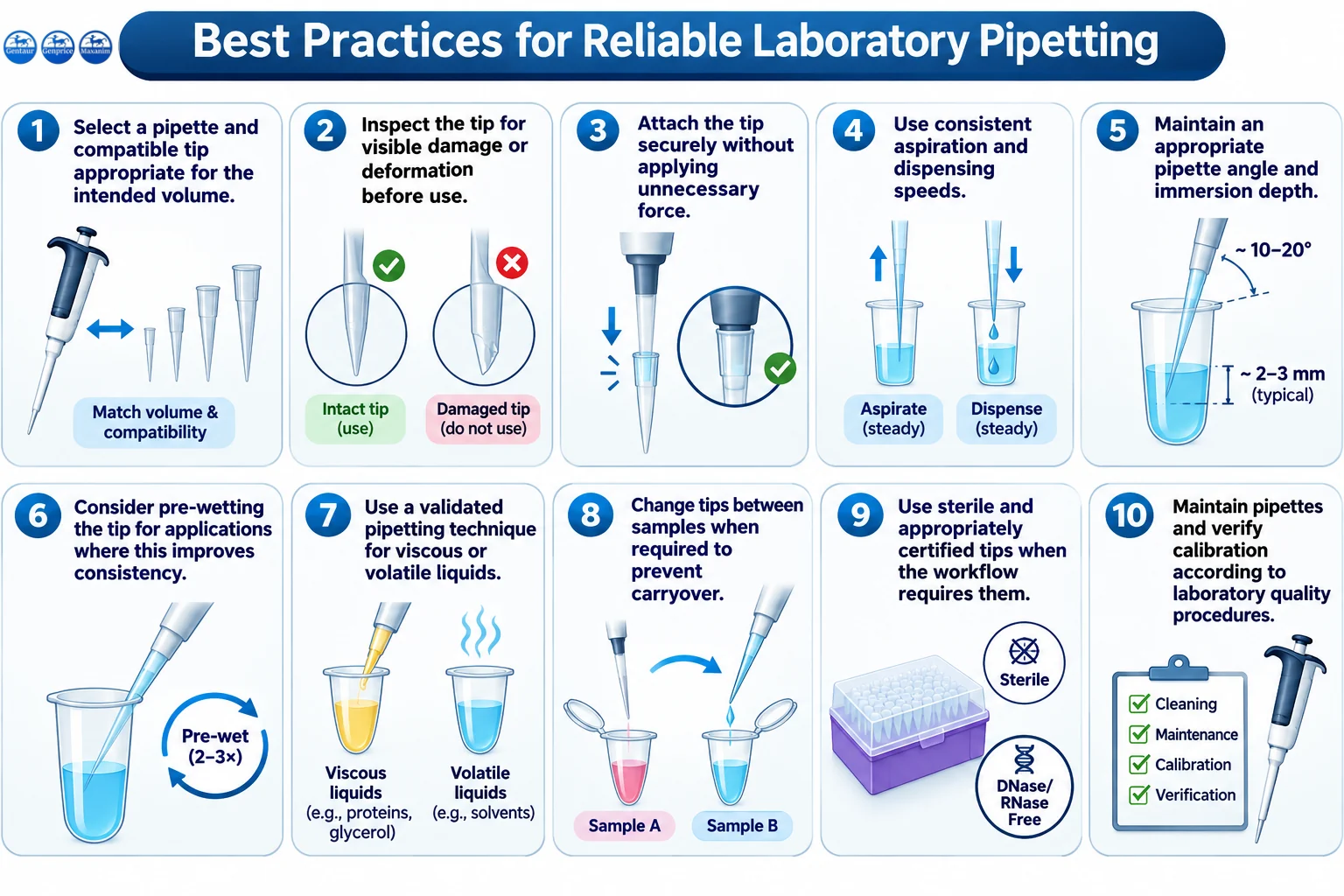
9. Best Practices for Reliable Laboratory Pipetting
Even when using high-quality pipette tips, experimental performance depends on proper pipetting technique.
Recommended Liquid-Handling Practices
Common Sources of Pipetting Error
Common sources of error include poor tip fit, inconsistent plunger operation, air bubbles, rapid aspiration of viscous liquids, inadequate dispensing, and improper tip reuse.
For trace-sensitive analytical procedures, the laboratory should also define appropriate controls for contamination, sample handling, and equipment maintenance.
Why Pipette-Tip Compatibility Matters
Not every tip fits every pipette correctly. A poor seal may affect the air cushion and compromise aspirated volume.
Tip compatibility should therefore be evaluated using the intended pipette model and volume range. Where required, the performance of the complete pipette-tip system should be verified using recognized gravimetric procedures.
10. Frequently Asked Questions About Laboratory Pipette Tips
What are the main types of pipette tips?
=> The main categories include standard, filter, low-retention, and low-retention filter pipette tips. Additional distinctions include sterility, nuclease cleanliness, geometry, and volume capacity.
What is the difference between filter and non-filter pipette tips?
=> Filter tips contain an internal barrier intended to reduce aerosol and droplet transfer toward the pipette. Non-filter tips do not include this barrier and are commonly used for general liquid handling.
Why are low-retention pipette tips used?
=> Low-retention tips are designed to minimize liquid remaining on the inner walls after dispensing. They may be useful for viscous solutions, detergents, and certain protein-containing reagents.
Are sterile pipette tips always RNase-free?
=> No. Sterility and RNase-free status are separate product specifications. Each must be verified using the relevant manufacturer's documentation.
Which pipette tips should be used for PCR?
=> Appropriately validated filter tips are commonly recommended for PCR workflows because they help reduce aerosol-related contamination risks. Required cleanliness specifications should also be checked.
Can one pipette tip fit all micropipettes?
=> No. Compatibility depends on the pipette cone design, sealing performance, and volume range. A tip should be verified as compatible with the intended instrument.
What does DNase/RNase-free mean?
=> It indicates that the product meets the manufacturer's specified criteria for detectable DNase and RNase contamination. It does not automatically confirm sterility or the absence of other contaminants.
What is the difference between 10 µL and 1000 µL pipette tips?
These tips differ in nominal capacity and physical geometry. A 10 µL tip is intended for microvolume transfer, while a 1000 µL tip supports larger volumes when used with a compatible pipette.
What are extended-length pipette tips used for?
=> Extended-length tips may help access samples in deep tubes or containers and can reduce the likelihood of the pipette shaft contacting the vessel opening.
How should researchers choose the right pipette tip?
=> Researchers should evaluate volume range, pipette compatibility, filter requirements, sterility, nuclease cleanliness, liquid retention, and packaging before selecting a tip.
Pipette tips are a fundamental component of accurate, reproducible, and contamination-conscious laboratory liquid handling.
Standard tips support routine procedures, filter tips address aerosol-related contamination risks, and low-retention tips can improve liquid recovery in suitable applications.
The availability of multiple volume ranges, geometries, sterile options, and DNase/RNase-free variants allows researchers to select consumables according to the specific requirements of molecular biology, immunology, microbiology, biochemistry, and analytical workflows.
For reliable experimental results, pipette tips should always be selected as part of a complete liquid-handling system that includes compatible instruments, validated procedures, and appropriate quality controls.